Tuesday, January 10, 2017
Fixture of Bangladesh’s tour of Sri Lanka March,20...
Sports 786: Fixture of Bangladesh’s tour of Sri Lanka March,20...: Bangladesh cricket team will go through busy schedule in this year. After playing a Test match for the first time in India in February, Tig...

Saturday, January 7, 2017
Messi, Suarez and Neymar returned to Barcelona training on Monday
FC Barcelona forwards Lionel Messi, Luis Suarez and Neymar Jr returned
to training on Monday. The three players brought a two week break to an
end and rejoined their team-mates, along with another South American, Javier Mascherano.
The four players were the only ones who hadn't returned yet after Gerard Pique opted to cut his Chirstmas break short (he was given the same time off as the others) and get back to work with the rest of the squad on Dec. 30.
Messi, Suarez and Neymar made their way on to the pitch together to begin preparing for Thursday's Copa del Rey games against Athletic Club at San Mames. Luis Enrique must decide if he will prioritise the cup game or if he prefers to manage their minutes ahead of Sunday's key league game at Villarreal.
The team have 72 hours to prepare for Athletic. Tuesday's training session will be open to the public at the Mini Estadi, with the players due to visit local hospitals afterwards.
Sportitalia have made an announcement: Barcelona have already made contact with Ronald Koeman to hear his thoughts on potentially managing the club.
According to the report, the Blaugrana are covering themselves in the case that Luis Enrique decides not to renew when his contract expires in the summer.
Koeman took over at Everton this season, replacing the sacked Roberto Martinez, and currently has the side seventh in the Premier League.
The Dutchman has never hidden his desire to coach Barcelona and in the case that Luis Enrique leaves, the door could be open for one of the Catalan club’s famous sons to return.
It was Koeman that scored the goal, of course, that gave Barça their first ever European Cup.
Luis Enrique’s current terms come to an end in June and he’s still not positioned himself on his future. He’s refused to answer questions about his renewal and has not closed the door on leaving in the summer.
“Well, the truth is that I don’t know,” he said in a recent interview over Christmas with the club’s television channel.
“I don’t doubt I’m at he best club, with the best players, at home, with my family, winning and enjoying things, but there’s also a part of this profession which is tough, which costs me a lot, which is a negative.”
The four players were the only ones who hadn't returned yet after Gerard Pique opted to cut his Chirstmas break short (he was given the same time off as the others) and get back to work with the rest of the squad on Dec. 30.
Messi, Suarez and Neymar made their way on to the pitch together to begin preparing for Thursday's Copa del Rey games against Athletic Club at San Mames. Luis Enrique must decide if he will prioritise the cup game or if he prefers to manage their minutes ahead of Sunday's key league game at Villarreal.
The team have 72 hours to prepare for Athletic. Tuesday's training session will be open to the public at the Mini Estadi, with the players due to visit local hospitals afterwards.
Sportitalia have made an announcement: Barcelona have already made contact with Ronald Koeman to hear his thoughts on potentially managing the club.
According to the report, the Blaugrana are covering themselves in the case that Luis Enrique decides not to renew when his contract expires in the summer.
Koeman took over at Everton this season, replacing the sacked Roberto Martinez, and currently has the side seventh in the Premier League.
The Dutchman has never hidden his desire to coach Barcelona and in the case that Luis Enrique leaves, the door could be open for one of the Catalan club’s famous sons to return.
It was Koeman that scored the goal, of course, that gave Barça their first ever European Cup.
Luis Enrique’s current terms come to an end in June and he’s still not positioned himself on his future. He’s refused to answer questions about his renewal and has not closed the door on leaving in the summer.
“Well, the truth is that I don’t know,” he said in a recent interview over Christmas with the club’s television channel.
“I don’t doubt I’m at he best club, with the best players, at home, with my family, winning and enjoying things, but there’s also a part of this profession which is tough, which costs me a lot, which is a negative.”
Saturday, October 24, 2015
Category:Football
From Wikipedia, the free encyclopedia

 |
Wikimedia Commons has media related to Football. |
Subcategories
This category has the following 14 subcategories, out of 14 total.A
C
F
G
P
R
T
V
Σ
Pages in category "Football"
The following 26 pages are in this category, out of 26 total. This list may not reflect recent changes (learn more).F
S
Use of the word "football"
For more details on this topic, see Football (word).
The word "football",
when used in reference to a specific game can mean any one of those
described above. Because of this, much friendly controversy has occurred
over the term football, primarily because it is used in different ways in different parts of the English-speaking world.
Most often, the word "football" is used to refer to the code of
football that is considered dominant within a particular region. So,
effectively, what the word "football" means usually depends on where one
says it.
Players assemble at the line of scrimmage in an American football game.
- Australia's association football governing body changed its name in 2005 from using "soccer" to "football"[101]
- New Zealand's governing body also changed in 2007, saying "the international game is called football."[102]
- Samoa changed from "Samoa Football (Soccer) Federation" to "Football Federation Samoa" in 2009.[103][104]
Football codes board
| Football | Cambridge rules (1848) | Association Football (1863) | ||
| Five-a-side | ||||
| Beach (1992) | ||||
| Futsal (1930) | ||||
| Sheffield rules (1857) | ||||
| Indoor | ||||
| Paralympic | ||||
| Street | ||||
| Rugby rules (1845) | ||||
| Rugby union (1871) | ||||
| Rugby sevens (1883) | ||||
| Rugby league (1895) | ||||
| Nines | ||||
| Beach rugby | ||||
| Touch football | ||||
| American football (1869) | Arena football (1987) | |||
| Canadian football (1861) | Flag football | |||
| Gaelic (1887) | International rules (1967) | |||
| Australian rules (1859) | ||||
Early history
Ancient games
According to FIFA the competitive game cuju is the earliest form of football for which there is scientific evidence.[10] It appears to be the first competitive game that involves kicking a ball through an opening into a net and occurs namely as an exercise in a military manual from the third and second centuries BC.[10] Documented evidence of an activity resembling football can be found in the Chinese military manual Zhan Guo Ce compiled between the 3rd century and 1st century BC.[11] It describes a practice known as cuju (蹴鞠, literally "kick ball"), which originally involved kicking a leather ball through a small hole in a piece of silk cloth which was fixed on bamboo canes and hung about 9 m above ground. During the Han Dynasty (206 BC–220 AD), cuju games were standardized and rules were established.[citation needed] Variations of this game later spread to Japan and Korea, known as kemari and chuk-guk respectively. Later, another type of goal post emerged, consisting of just one goal post in the middle of the field.[citation needed]The Ancient Greeks and Romans are known to have played many ball games, some of which involved the use of the feet. The Roman game harpastum is believed to have been adapted from a Greek team game known as "ἐπίσκυρος" (Episkyros)[12][13] or "φαινίνδα" (phaininda),[14] which is mentioned by a Greek playwright, Antiphanes (388–311 BC) and later referred to by the Christian theologian Clement of Alexandria (c.150-c.215 AD). These games appear to have resembled rugby football.[15][16][17][18][19] The Roman politician Cicero (106–43 BC) describes the case of a man who was killed whilst having a shave when a ball was kicked into a barber's shop. Roman ball games already knew the air-filled ball, the follis.[20][21] Episkyros is recognised as an early form of football by FIFA.[22]
The Japanese version of cuju is kemari (蹴鞠), and was developed during the Asuka period.[citation needed]This is known to have been played within the Japanese imperial court in Kyoto from about 600 AD. In kemari several people stand in a circle and kick a ball to each other, trying not to let the ball drop to the ground (much like keepie uppie). The game appears to have died out sometime before the mid-19th century. It was revived in 1903 and is now played at a number of festivals.[citation needed]
There are a number of references to traditional, ancient, or prehistoric ball games, played by indigenous peoples in many different parts of the world. For example, in 1586, men from a ship commanded by an English explorer named John Davis, went ashore to play a form of football with Inuit (Eskimo) people in Greenland.[23] There are later accounts of an Inuit game played on ice, called Aqsaqtuk. Each match began with two teams facing each other in parallel lines, before attempting to kick the ball through each other team's line and then at a goal. In 1610, William Strachey, a colonist at Jamestown, Virginia recorded a game played by Native Americans, called Pahsaheman.[citation needed] On the Australian continent several tribes of indigenous people played kicking and catching games with stuffed balls which have been generalised by historians as Marn Grook (Djab Wurrung for "game ball"). The earliest historical account is an anecdote from the 1878 book by Robert Brough-Smyth, The Aborigines of Victoria, in which a man called Richard Thomas is quoted as saying, in about 1841 in Victoria, Australia, that he had witnessed Aboriginal people playing the game: "Mr Thomas describes how the foremost player will drop kick a ball made from the skin of a possum and how other players leap into the air in order to catch it." Some historians have theorised that Marn Grook was one of the origins of Australian rules football.
The Māori in New Zealand played a game called Ki-o-rahi consisting of teams of seven players play on a circular field divided into zones, and score points by touching the 'pou' (boundary markers) and hitting a central 'tupu' or target.[citation needed]
Games played in Mesoamerica with rubber balls by indigenous peoples are also well-documented as existing since before this time, but these had more similarities to basketball or volleyball, and since their influence on modern football games is minimal, most do not class them as football.[citation needed]Northeastern American Indians, especially the Iroquois Confederation, played a game which made use of net racquets to throw and catch a small ball; however, although it is a ball-goal foot game, lacrosse (as its modern descendant is called) is likewise not usually classed as a form of "football."[citation needed]
These games and others may well go far back into antiquity. However, the main sources of modern football codes appear to lie in western Europe, especially England.
-
 A Song Dynasty painting by Su Hanchen, depicting Chinese children playing cuju.
-

-
 A revived version of kemari being played at the Tanzan Shrine, Japan.
-
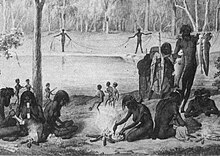 An illustration from the 1850s of Australian Aboriginal hunter gatherers. Children in the background are playing a football game, possibly Woggabaliri.[24]


Subscribe to:
Comments (Atom)